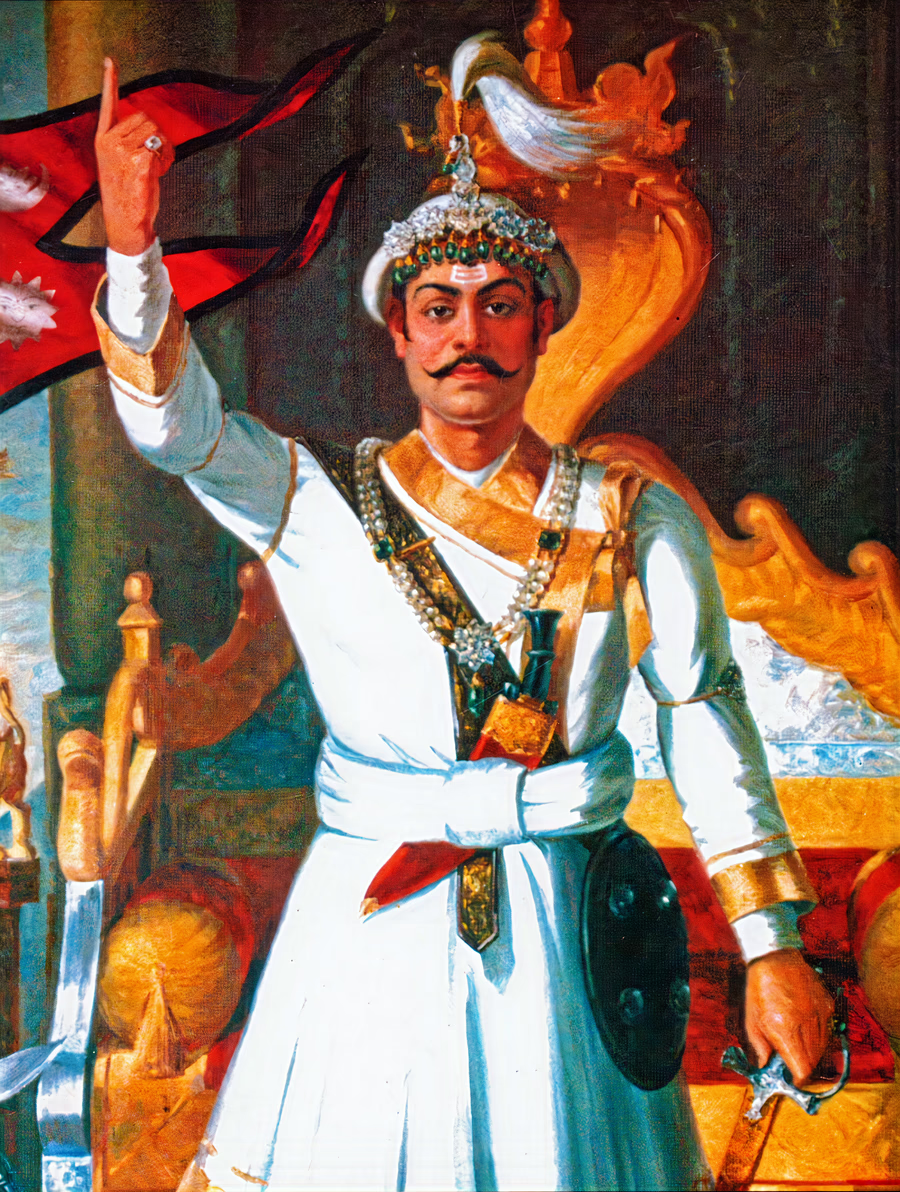
Unification of Nepal
A timeline of the unification campaign led by Prithvi Narayan Shah of Gorkha and his successors, forming the foundations of modern Nepal.
12 entries
At age 20, Prithvi Narayan Shah became king of Gorkha following the death of his father, Nara Bhupal Shah. He recognized the fragmented political landscape of the region and began laying the groundwork for a unified Nepal. He strengthened his military, forged alliances with neighboring hill states, and focused on consolidating power and preparing for territorial expansion.
- Reorganized Gorkha administration
- Built strategic alliances, including with Lamjung
- Set the vision for a unified Nepal
Gorkha forces, led by Kalu Pande, captured Nuwakot in a decisive victory, controlling a key trade route between Tibet and the Kathmandu Valley. This marked the first major success in the unification campaign, providing a strategic foothold near the valley and disrupting enemy trade networks. (Note: A prior failed attempt occurred in 1742.)
- Secured trade route to Tibet via Kerung
- Established a base near Kathmandu Valley
- Boosted military confidence
The first assault on Kirtipur ended in defeat for Gorkha forces, with heavy casualties including the death of Commander-in-Chief Kalu Pande. This battle tested Gorkha resolve and led to the promotion of new leaders like Dhiraj Thapa as commander.
- Major military setback
- Death of key general Kalu Pande
- Led to army reorganization
Gorkha forces defeated the Sen dynasty of Makwanpur, annexing the kingdom and gaining control over southern trade routes. This victory cut off Kathmandu's access to Indian plains and provided captives, including royal family members, to bolster Gorkha's position.
- Defeat of Digbandhan Sen
- Control over Tarai access
- Strategic encirclement of Kathmandu Valley
In revenge for earlier defeats, Gorkha forces captured Kirtipur after a fierce siege. The victorious soldiers mutilated the defenders by cutting off noses and lips, a harsh act that shocked the valley kingdoms but secured a vital gateway to Kathmandu.
- Harsh reprisal against defenders
- Opened path to Kathmandu Valley
- Forced tactical innovations in siege warfare
Exploiting internal divisions among the Malla kings, Gorkha forces launched a surprise attack and captured Kathmandu. This decisive turning point ended Malla rule in the valley's core and established Shah dynasty control, consolidating Gorkha authority.
- End of Kantipur’s Malla rule under Jaya Prakash Malla
- Centralized power under Gorkha
- Major boost to unification momentum
Following Kathmandu's fall, Patan surrendered peacefully to avoid destruction, with Tej Narasingh Malla abdicating. This allowed Gorkha to consolidate control without widespread damage, further cementing authority over the valley and preserving its cultural heritage.
- Minimal resistance led to quick surrender
- Preservation of city infrastructure and temples
- Strengthened Gorkha control
Gorkha forces, after a prolonged siege, captured Bhaktapur, defeating Ranajit Malla and ending Malla rule in the valley. Kathmandu was declared the capital, completing the unification of the three major valley kingdoms under the Shah dynasty and laying the foundation of modern Nepal.
- End of centuries-long Malla rule
- Unified three major valley kingdoms
- Established political and cultural centralization in Kathmandu
With the valley secured, Shah forces under commanders like Swarup Singh Karki annexed western principalities such as Kaski (1775), Tanahun, and parts of the Sapta Gandaki region. This period integrated diverse ethnic groups and extended Nepal's influence westward.
- Annexation of Kaski and Tanahun
- Integration of diverse populations like Magars and Gurungs
- Expanded territorial control to the Seti River
Under the command of Ram Krishna Kunwar and Abhiman Singh Basnyat, Gorkha forces invaded the Kirant (Limbuwan and Khambuwan) regions, defeating local rulers and annexing territories up to the Tista River. This expanded Nepal's eastern frontier significantly.
- Victory over Kirant kings like Karna Sen
- Integration of Limbuwan and Khambuwan
- Extended borders to Sikkim
Prithvi Narayan Shah passed away at Devighat in Nuwakot at age 52. He left a unified core state encompassing the Kathmandu Valley and surrounding regions, with his son Pratap Singh Shah succeeding him. His 'Dibya Upadesh' (Divine Counsel) guided future rulers.
- Unified political entity from fragmented states
- Legacy carried forward by successors like Pratap Singh Shah
- Foundation for modern Nepal's borders
Under Pratap Singh Shah (r. 1775–1777), Rajendra Laxmi (regent), and Bahadur Shah (commander until 1792), Nepal expanded dramatically westward to the Sutlej River and eastward to Sikkim. Key annexations included Jumla (1789), Doti, Kumaon, and Garhwal (1790), but overextension led to the Anglo-Nepalese War (1814–1816), resulting in territorial losses via the Treaty of Sugauli.
- Annexations under Pratap Singh and Bahadur Shah
- Peak extent twice modern Nepal's size
- Consolidation challenged by British intervention